What to Include in a Cruise Quote (So Your Client Actually Understands It)
Cruise quotes fail differently than land quotes. Here's every element a cruise proposal needs — cabin categories in plain English, all-in pricing, promo value, and the traps that create post-booking surprises.
Cruise quotes fail differently than land quotes.
With a hotel, the client mostly understands what they're buying — a room, some nights, a rate. With a cruise, almost nothing is self-evident. The advertised fare isn't the price. The cabin has a two-letter code and four tiers of "balcony." Half the value is in a promotion whose worth nobody has explained. And the ship itself is the destination for a third of the trip.
That gap is where cruise bookings get lost — not to a competitor, but to confusion. This is what belongs in a cruise quote so that doesn't happen.
Start with the fundamentals
The ship, the line, and the class
Name the ship, not just the line. "Norwegian Cruise Line" tells a client nothing; Norwegian Aqua, one of the newest ships in the fleet tells them a great deal. If the ship is new, recently refurbished, or notably large or small, say so — that's a material part of what they're buying.
Sailing dates and length
Dates plus nights. Both. "August 22–29" and "7 nights" read as different pieces of information to a client trying to book time off work.
Where it leaves from — and where it ends
Round-trip or one-way, and from which port. This sounds obvious until you've had a client book flights home from the wrong city on a repositioning sailing. Spell it out.
The itinerary — including the days at sea
List every day: port, arrival, departure. Then do the two things most quotes skip.
Flag the sea days as a feature, not a gap. A client who doesn't cruise often reads "at sea" as "nothing happens." It's often the best day of the trip. One sentence fixes it.
Call out scenic cruising by name. Glacier Bay, Endicott Arm, the Chilean fjords, Geirangerfjord — these are frequently the single most memorable morning of the sailing, and they're invisible on a port list because the ship never docks.
And show real port times. A 7:00 AM arrival in Ketchikan means an early morning; an 11:59 PM departure from Victoria means a late night. Managing that expectation in the quote costs you a sentence. Managing it after booking costs you goodwill.
Cabin categories — in English, not codes
This is the single biggest translation job in a cruise quote, and it's where a specialist earns their fee.
Supplier material arrives as "BA," "M1," "GTY," "OV obstructed." None of that means anything to your client. Convert it:
- Interior — no window. Genuinely fine, remarkably dark, the best value on the ship.
- Oceanview — a window that doesn't open. Ask whether it's obstructed — a lifeboat outside the glass is a real thing and a real complaint.
- Balcony — private outdoor space. On scenic itineraries (Alaska, Norway, the fjords) this is where the money is best spent, and it's worth saying so.
- Suite — more room, and usually a bundle of perks (priority boarding, specialty dining, a concierge). Price the perks, not just the square footage.
Then add the things only an advisor knows:
Deck and location matter. Midship is steadier. Directly under the pool deck means chairs dragging at 6 AM. Above the theater can mean noise. If you know, tell them — this is exactly the kind of detail that makes a client feel they were right to use you.
Guarantee vs. assigned. A "GTY" cabin means the line assigns your stateroom later. It's usually a lower price and sometimes an upgrade — but the client cannot choose, and they may end up somewhere they'd rather not be. Never put a guarantee cabin in a quote without explaining this in one plain sentence.
Occupancy — the trap hiding in "per person"
Cruise fares are quoted per person, based on double occupancy, and this is the most common source of sticker shock in the entire category.
Show both numbers. Per person and the total for the party. A client reading "$1,699" and mentally budgeting $1,699 for the trip is a client who will be unhappy later, and it will feel like your fault.
Then handle the edge cases explicitly:
- Third and fourth guests are usually cheaper — say how much.
- Solo travelers typically face a single supplement, sometimes near double. Name it up front.
- Cabin capacity is real. Not every stateroom sleeps four. Confirm before you quote it.
Pricing that's actually all-in
Three components, always, and always totaled:
- Cruise fare — per person
- Taxes, fees and port expenses — per person, and frequently $200–400 on a week-long sailing
- Gratuities — either prepaid or charged onboard daily; either way, say which
Cruise fare — $1,699 per person Taxes, fees & port expenses — $245 per person Total for two guests — $3,888 all-in
Port fees are the number one post-booking surprise in cruise. They're also completely avoidable with one line in the quote.
Promotions — priced, not just named
"Princess Plus included" or "free at sea" means nothing to a client who doesn't cruise. Translate the promo into what it covers and roughly what it's worth.
Princess Plus included — Wi-Fi, drinks package and crew appreciation for both guests. Bought separately, roughly $60 per person per day.
Suddenly a fare that looked high looks like a deal. This is one of the highest-value sentences you can put in a cruise quote, and almost nobody writes it.
Also note the promo's expiry. Cruise promotions move constantly, and "this fare includes the current promotion, which ends Friday" is honest urgency you didn't have to invent.
Payment terms
- Deposit — amount per person and whether it's refundable
- Final payment date — cruise final payments come due months before sailing and clients routinely forget
- Cancellation schedule — at least a pointer to how penalties escalate
What's not included
Flights, transfers to the port, shore excursions, specialty dining, spa, Wi-Fi (if not in the promo), and anything bought onboard.
Say it plainly. The "not included" list is the cheapest trust you will ever buy.
Insurance
Recommend it, and say why in one sentence specific to cruise: final payment lands months early, penalties escalate steeply, and medical care at sea or in a foreign port is not covered by most domestic health plans.
What that adds up to
Here's a real cruise proposal with all of the above built in — flip it between six designs to see how the same information can read completely differently:
BAHAMAS
4 Nights Bahamas & Perfect Day Cruise
Day by day
Bahamas
4 Nights Bahamas & Perfect Day Cruise
Oceanview Balcony

Ultra Spacious Oceanview Balcony

Day by day
Bahamas
4 Nights Bahamas & Perfect Day Cruise
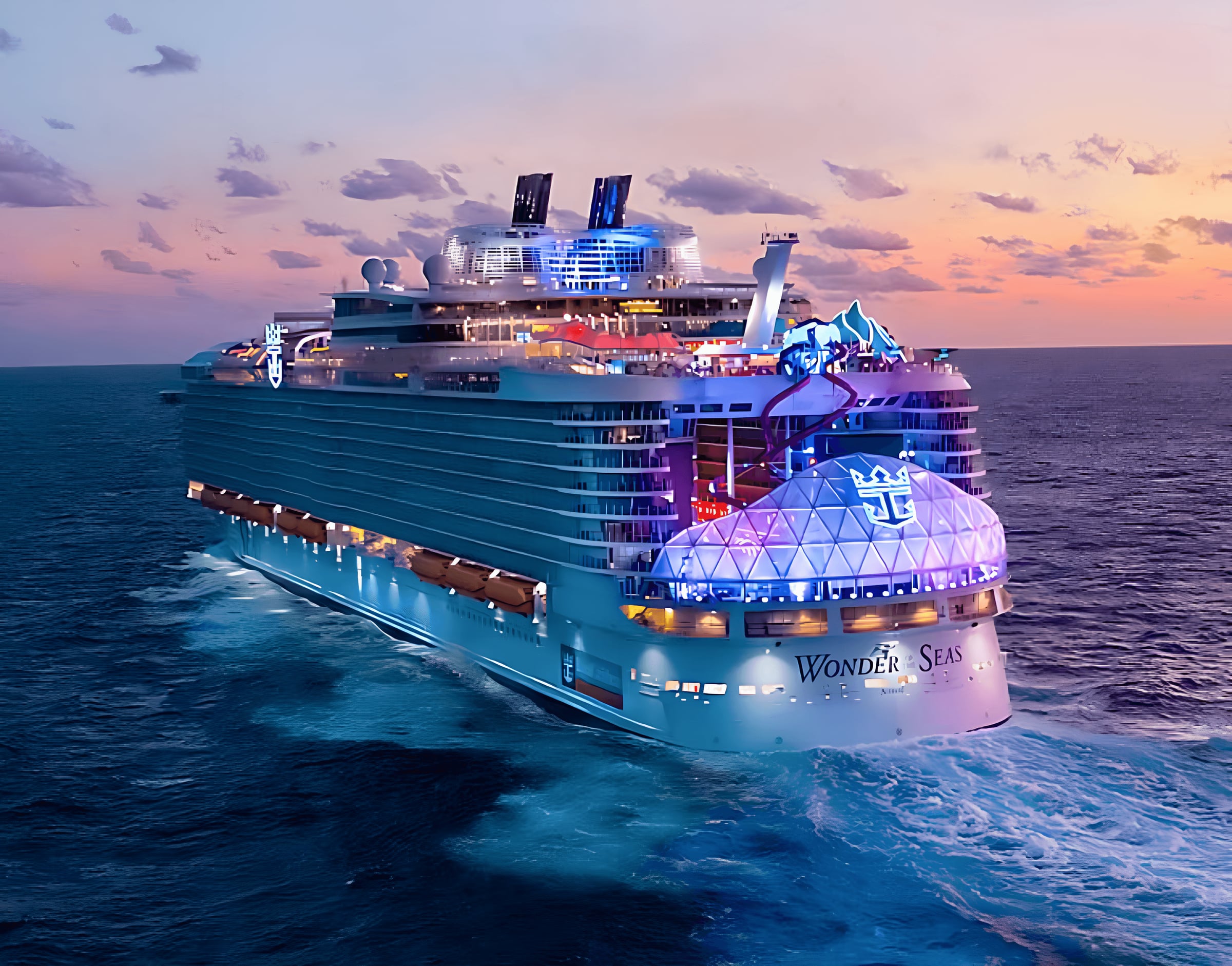
A 4-night sailing aboard the Wonder of the Seas — departing Port Canaveral on Aug 17, 2026.
Day by day
The six things that cause almost every post-booking surprise
If you fix nothing else, fix these:
- Port fees presented separately from the fare, or not at all
- "Per person" never converted to a party total
- Guarantee cabins quoted without explaining the client can't choose
- Obstructed views not disclosed
- Gratuities left ambiguous — prepaid or onboard?
- Final payment date buried or omitted
Every one of these is a one-line fix in the quote, and every one of them is a difficult phone call later.
Why this takes so long — and why it shouldn't
Everything above already exists. It's sitting in the supplier email, the fare grid, the deck plan and the promo sheet. The work isn't knowing it — you already do. The work is transcribing it into something a client can read, and then doing that again on the next quote, and the one after that.
That's the part VoyageLine removes. Paste the supplier email or drop a screenshot of the fare grid, and we pull out the ship, sailing dates, itinerary, cabin categories and fares. You review every field — you're the one who knows whether that balcony is on the glacier side — and it publishes as a branded proposal your client opens on their phone. When they tap Ready to book, you know immediately.
We're built specifically for cruise, which is why staterooms, decks, ports and sea days are first-class parts of the layout rather than fields crammed into a generic proposal form.
For the broader structure behind any proposal, read How to make travel proposals that win bookings. For a copyable section-by-section framework, see the travel proposal template.
Your next cruise quote, minus the transcription. First three proposals free — no card, no demo call. Build one free →
Keep reading
The Best Cruise Quote Software for Travel Agents (2026)
Six tools advisors actually use for cruise quoting, what each is best at, and the honest trade-offs. Written by the team behind one of them — we say so up front.
How to Present Pricing in a Travel Proposal (Without Losing the Booking)
Hiding the price feels safer and closes slower. Here's how to present travel pricing so clients feel in control instead of ambushed.
How to Make Your Travel Proposals Look Professional (Without a Designer)
A client decides whether you look like a professional operation in about ten seconds — before they've read a single detail. Here's what actually drives that judgment.